

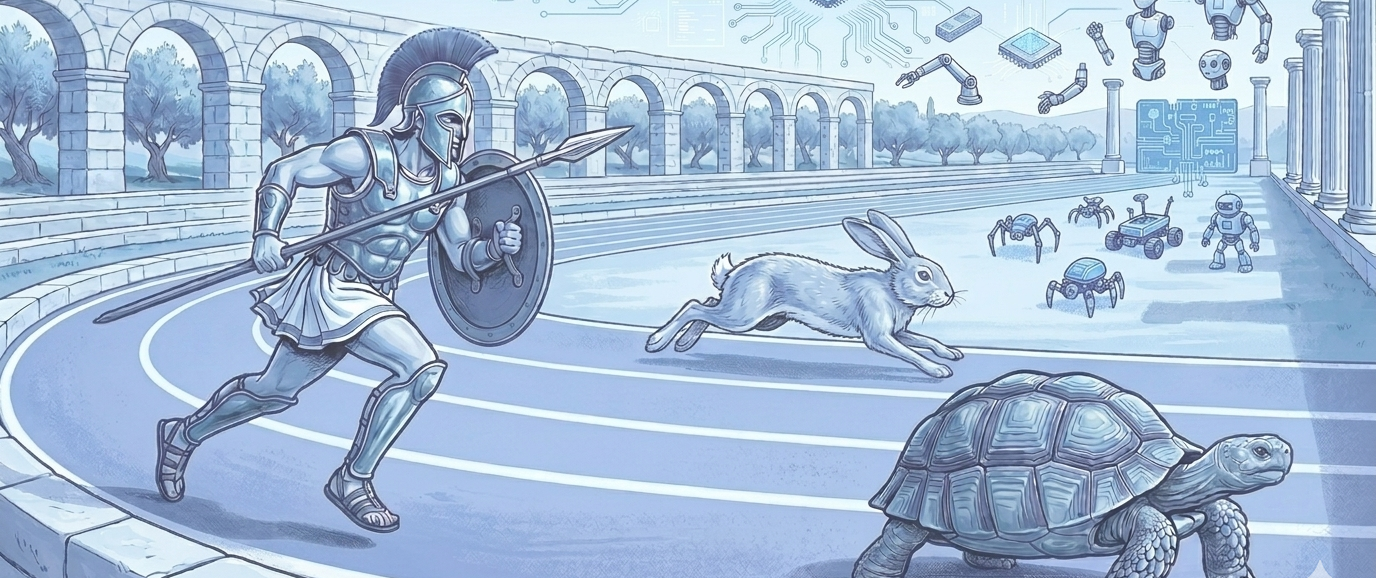
The Tortoise and the Hare or an ancient Greek Hero and a Paradox
Written By: Karsten Heise, Senior Director of Strategic Programs and Innovation
Many have wondered why a robotic tortoise and hare appear on GOED’s Innovation Based Economic Development (IBED) Webpage. What does it all mean? Frankly, this is a valid question.
Although the Tortoise and Hare is an age-old analogy of perseverance versus impatience, the message that we are trying to convey is a little more nuanced. At its core lies a paradox that poses deep mathematical and philosophical interpretations and a controversy over solutions. While we do not claim any expertise in advanced mathematics, we invoke this paradox to champion science and innovation. So, let me explain.
An Ancient Paradox
Why a 2,500-year-old paradox and a debate ever since might be useful to illustrate the importance of innovation
Let’s start with the basics. About 2,500 years ago, a Greek philosopher named Zeno of Elea wrote a book of paradoxes. One of them describes the race of the hero of the Trojan War, Achilles, and a tortoise. We replaced the hero with a hare to avoid the confusion that might arise from featuring an ancient Greek warrior racing a tortoise populated our IBED webpage.
 The Zeno paradox goes like this: the tortoise is given a head start in the race. In order for Achilles to overtake the tortoise he must first catch it. However, while the hero covers the initial gap, the tortoise has already moved on, creating a new gap. Similarly, as the warrior covers the second gap, the creature moves on to create a third gap. And so, it continues ad infinitum.
While the gap is shrinking, Achilles will still never catch up with the tortoise. Zeno’s argument is based on the logic that Achilles must cover an infinite number of times to reach the tortoise (the individual gaps that are being closed each time). An infinite number of times equals an infinite amount of time. The question now is what the solution to the paradox is, which is in essence a paradox of infinity[1]. Finding the solution, indeed if there is one, is less straightforward than you may think, which is exactly why the race features as an animation on our webpage.
Let us look at a critique of, as well as a possible solution to, the Paradox. The first pertains to Aristotle, whose main criticism targets the treatment of infinity by arguing that the distances the runner needs to pass can be subdivided indefinitely, but the sum of those ever-shorter distances will be finite. This is, however, not the same as passing over an infinite number of parts. If Achilles or the hare has to cover an infinite number of decreasing distances, they will still take a finite time. Eventually, they will catch the tortoise[2].
Importantly, Aristotle homes in on the key idea that is the difference between the absence of a limit to divisibility (i.e. the progressively decreasing number of gaps that Achilles or the hare must close) and the possibility of having already divided something an infinite number of times.  This reflects the idea of a continuum where an infinite sum of division converges to a finite amount[3]. This so-called Standard Solution to the Paradox, departing from Aristotle, uses modern mathematics, such as calculus, not available during both Zeno and Aristotle’s times[4]. The innovation of new forms of mathematics enabled us to deal with infinite sums of decreasing terms, and through this theory it can be shown that the sum converges into a well-defined and finite answer.
The Importance of Modern Science, Discovery and Innovation
Why the Ancient Paradox does not end with the invention of calculus and what this has to do with quantum mechanics and scientific discovery
We could end here because, after all, the convergence of infinite series explains countless phenomena we observe in the world. We have demonstrated that an ancient thought experiment leading to a paradox and its possible solutions symbolize the role that research and its application through experimentation and innovation play in advancing our understanding of the world and mankind. However, science and its application through innovation constantly move forward across millennia, and so the story does not end here.
Carlo Rovelli argues that there can be a solution to the Zeno Paradox without using the continuum as an explanation[5]. And to top it all off, the alternative explanation put forward by Rovelli in the 21st century can trace a link to Democritus of Abdera, who lived around 450 BCE. Democritus argued that the universe is made up of boundless space, and space is without limits; and in that space, countless atoms move freely, colliding or hooking on to another. However, Democritus observed that matter cannot be a continuous whole. If we broke up matter piece by piece, what would be left? Hence, he argues that any piece of matter is made up of a finite number of individual pieces that are themselves indivisible, with each one having a finite size: the atoms[6].
Fast forward into the 21st century, Carlo Rovelli invokes loop theory[7], which asserts that space is not a continuum (recall that a continuum was the prerequisite for the Standard Solution to the Paradox and enabling convergence of an infinite series). According to this theory, space is not infinitely divisible. Similarly, volume cannot be arbitrarily small. Achilles, or the hare, does not need infinite numbers of steps to catch up with the tortoise. According to this argument, infinitely small gaps to be closed do not exist. Achilles, or the hare, will get ever closer to the tortoise and reach it in a final, single quantum leap.
Are we therefore back to 450 BCE and Democritus, rendering the progress made since then redundant?
As Rovelli argues, we aren’t. Without developments in science and mathematics, we would not be able to develop and explain our understanding; but it also means that by constantly exploring and innovating, we are building on the concepts, theories, and achievements of the past. According to Democritus, “the truth is in the depth.” Hence, scientific discovery and innovation constantly test the limits of our knowledge.
Ignorance is the polar opposite to scientific thinking, discovery and innovation. The Paradox reminds us that we should be constantly reexamining and challenging our beliefs. Science and Innovation always represent a snapshot in time. They represent the best possible approximation to reality, answers and solutions to challenges facing humanity. But science and innovation are never finite, definite or perfect. Science and innovation are perpetual paths to ultimate truth, without ever reaching it.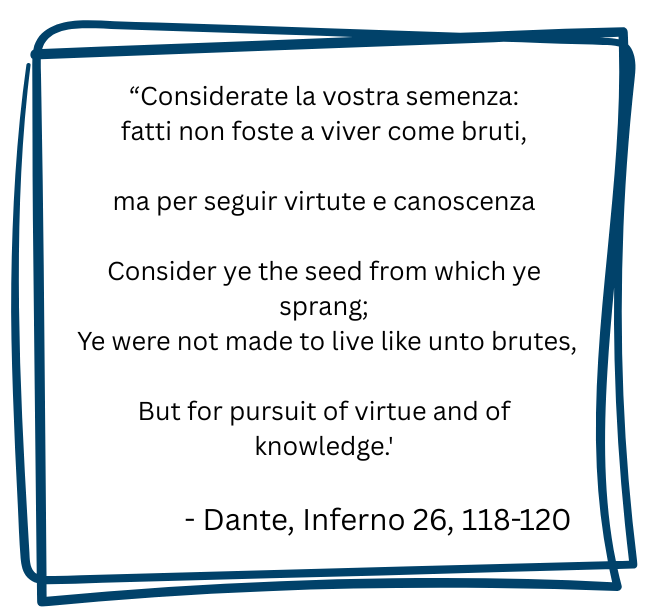 They are perpetually challenging the current truths and technological solutions. Scientists, innovators, and entrepreneurs constantly take on the status quo and our ignorance, often born out of fear. They are disruptors and driven by constant distrust in certainty. Dante reminds us through Ulysses in the Inferno that our destiny is not to live like ignorant brutes, but to seek virtue and knowledge.
And as the Paradox and the millennia-old debate has shown, it can be hard to catch up if your opponent possesses a “first mover advantage.” The same holds true for investments in science and innovation.
Investments in science and innovation are crucial not just to further explanations of nature’s phenomena but also to guarantee competitiveness in developing innovative solutions to real world challenges and problems.
All this is why there is a Hare and a Tortoise on the IBED webpage.